Facilities in Montparnasse
"I love art today because I love light above all and all men love light above all, they invented fire." Apollinaire, 1913[1]
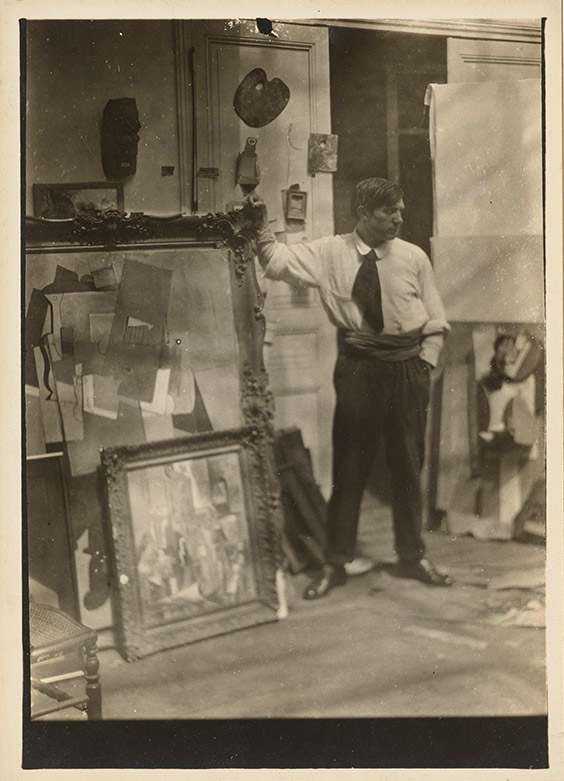
Apollinaire was a privileged witness to the development of his friend's work while he prepared Les Peintres cubistes, a book in which he reflected on Picasso's latest explorations. The poet's enthusiasm about Picasso's painting was apparent again in a series of articles about contemporary art published in 1912. Picasso, for his part, made a change in his life that year, leaving Montmartre and his partner Fernande to settle in Montparnasse with his new love, Eva. This working-class neighborhood attracted many artists and became the center of the city's cultural life. Still relatively undeveloped and affordable, it offered low rents for studio spaces and cheap cafés that welcomed the penniless artists who met there daily. The district's history is closely linked to the famous names who found refuge in the area. Apollinaire also left Montmartre and the Bateau-Lavoir to join his friend, who had moved to the Boulevard Raspail. The poet took particular interest in Picasso's new experiments, consisting of Cubist works produced with recycled materials. The closeness between the two friends is apparent in this short letter sent by Picasso from Sorgues: "My dear Guillaume, by now you must have received a letter from me and a postcard that I sent the day before yesterday from Avignon. I'll probably leave Avignon on Monday evening and be in Paris by Tuesday morning. We can meet when I'm back and choose the photographs. Your old buddy, Picasso."[2]
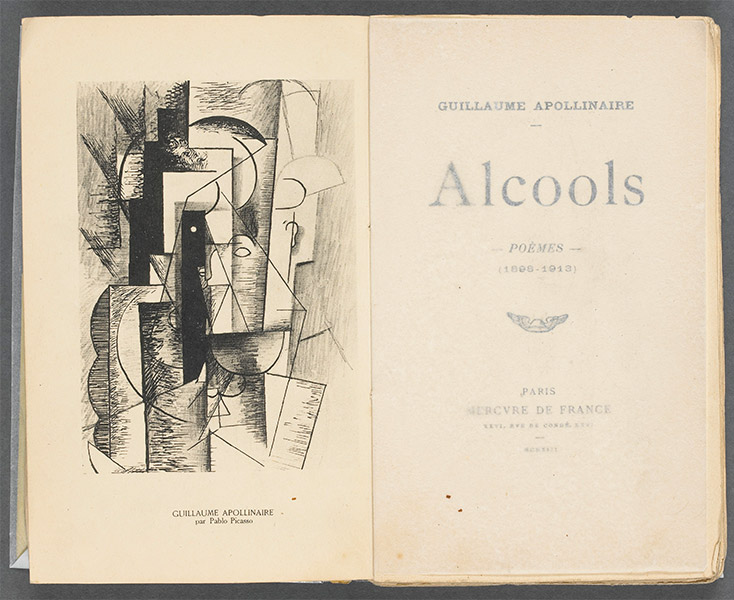
The prospects for the year 1913 were very promising in France. Picasso was happy in Montparnasse. Apollinaire and he were close. Picasso wrote to his friend: "My dear Guillaume, I received your book, Alcools. You know how much I love you and you know the joy I feel when I read your poems. I'm very happy [...]."[3] We know how delighted the artist was with the book for its conception, its historical references, its organization, and its lack of punctuation. Both artists challenged the prevailing conventions for understanding and reading a text. They both shared a culture of love, modernity, and unabashed eroticism that sublimated the rawness of the narrative or the painting. Alcools, a multi-faceted, polyphonic, experimental work that compiled fifteen years of poetry writing into one volume, became a landmark in French literature.
A group of artists gathered in Montparnasse, including Picasso, the Derains (Alice and André), Severini, Boccioni, De Chirico, André Salmon and, of course, Max Jacob. Apollinaire and Picasso observed modern urban life, a world that was changing at a frantic pace. Apollinaire translated into words his feelings about the new forms he encountered. With his delicate lyricism, his infinitely varied means of expression and a bold use of form, he gave poetry a decisive impulse. Frequenting modern art circles, Picasso and Apollinaire joined them in dreaming of a disruptive world shaped by a future-oriented and resolutely active imagination.
In July of that year, when Picasso had left for the South of France, Apollinaire sent him a long letter and a few poems he was in the process of writing, such as "La Pipe et le Pinceau."
[1] Apollinaire, Les peintres cubistes, 1913.
[2] Letter from Picasso to Apollinaire, dated September 22, 1912. The photographs he mentions were supposed to be published in Les Peintres cubistes. Picasso/Apollinaire, correspondance, op. cit., p. 96.
[3] Letter from May 29, 1913, held at the Musée national Picasso-Paris.
7 / 10



 Summary