The same vision of the world
In the catalogue for the exhibition Eluard et ses amis peintres (Centre Pompidou, Musée national d’Art moderne, Paris, 1982), Jean-Charles Gateau (1932-2015) wrote: "not a single poet of this century, and I choose my words carefully, has loved painting like Eluard. In the sweet anticipation of seeing the unseen arise from nothing, in the joy of sharing and creative emulation, Eluard always kept close to the eye and to the hand."
They first met in 1926. At the time, Picasso was 45, and Eluard (a pseudonym for Eugène Grindel) was 31. Until 1935 their relationship appears to have been rather distant, but their shared acquaintance with the Zervos couple and their regular contact with the Cahiers d’Art journal brought them closer. Picasso enjoyed the poet's cheerfulness and his aversion to convention. According to Ségolène Le Men (in her essay on their relationship, published in La Gazette des beaux-arts in 1983), "They shared the same worldview, although each kept his own identity and respected the other's difference, which made them complementary." In Jean-Charles Gateau's view, "In Eluard, Picasso found a very different interlocutor from Breton; charming, refined, undogmatic, disdaining neither the passion nor the bawdiness of alcohol, and a sworn enemy of conventions."
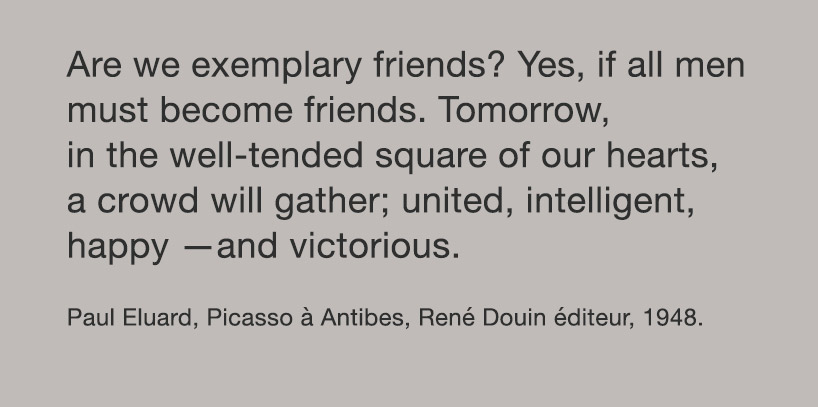
Paul Eluard enjoyed the company of painters and collaborating with them, holding the belief that collaboration was only possible if both parties gave each other total freedom. "A painter faces a poem like a poet faces a painting: he dreams, imagines, creates." It was following this conviction, which he applied to his everyday exchanges with others, that the poet developed an exceptional relationship with Max Ernst. Curious by nature, he sought to understand the poetic evidence in the paintings he admired. Eluard enjoyed the reciprocal affinity with Picasso, and wanted his friend to know that he was not one of those who frequented him out of interest. In Picasso à Antibes, referring to the artist's friends, he wrote: "Good people, true friends, always ready to befriend each other, to stretch out their paw like honey bears. But you, Picasso, are the one they kiss first, because they feel indebted to you for regulating their behavior. You make them humble and proud, in the sphere of the bumps and bruises of men among men. You teach them that it's good to live a happy utopia, a childhood dream of an endless vacation, but you also make them want to understand and see everything; you give them the everyday courage to refuse to surrender to deadly appearances […]"
1 / 8



 Summary