Dramas, marriages, and passion for art
Picasso and Eluard saw each other in Southern France in 1946, when Eluard was a jury member at the Cannes Festival.
In November 1946, Nusch suddenly died. Eluard was devastated by this dramatic, totally unexpected loss, which also affected Picasso deeply. We know that the artist was very fond of the pretty muse and aesthete who died at a turbulent time. Picasso helped his friend overcome his grief ("You convince me that I can still see the one I loved, even if I cannot touch her.") Utterly distressed, Eluard attended the heated debates about the Party's views on art and participated in several congresses, slowly recovering from his partner's death. Despite his sorrow, he defended his ideas and did not cease to reaffirm the strength of his conviction that art had to be independent. Eluard continued to publish, producing Picasso à Antibes, a prose poem illustrated with 88 photographs by Michel Sima. He also travelled. On one of his trips —to Mexico in 1947— he met Dominique (born Odette Lemort), after having a romance with a young worker, Jacqueline Duhême, whom the Party advised him not to marry. Upon his return, he wrote a text for Alain Resnais' documentary on Guernica. Eluard travelled with Dominique to Czechoslovakia, Bulgaria, and Moscow. He was greeted warmly everywhere, and, as Pierre Daix wrote, "did not see, or chose not to see, the terror." In 1948, Eluard published Voir, a tribute to his painter friends, the privileged fellow viewers who illustrated his writings. In this book he showed his love of art, and, above all, offered the artists a space for freedom, unconstrained by any political ideology.
He married Dominique in Saint-Tropez in 1951; Picasso and Françoise Gilot acted as witnesses. Picasso's wedding gift was a large decorated vase, and at the reception meal he drew the guests gathered around the table. Françoise Gilot and Picasso went back to visit the couple in Saint-Tropez several times over that summer.
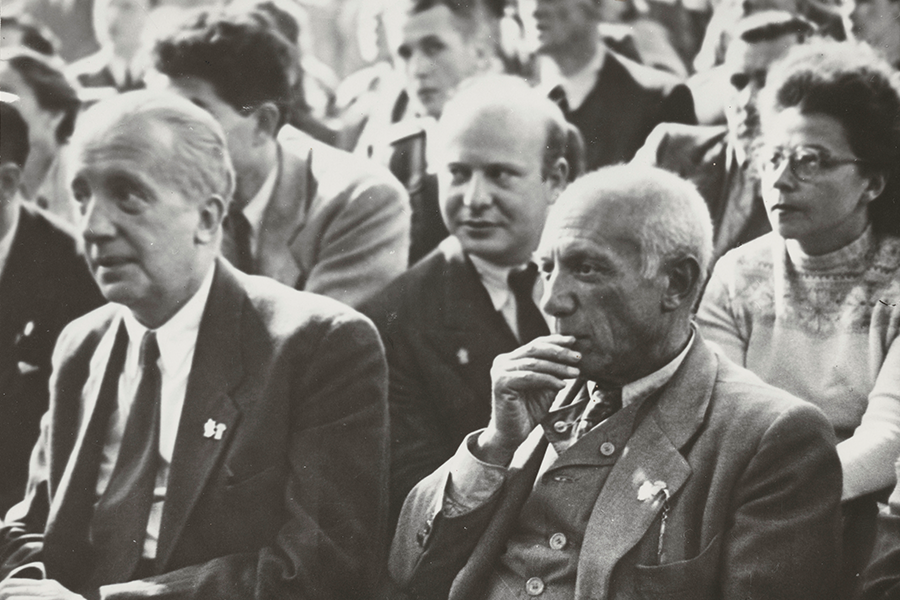
Paul Eluard died suddenly on November 18, 1952. In addition to his friend, Picasso lost someone who had been able to delve into the intimacy of his work, someone with whom he shared a straightforward connection without ulterior motives, someone who was capable of understanding him and in whom he confided sincerely. Eluard had given the artist the opportunity to develop his love of words and literature, of verse and poetry. At Eluard's funeral, Picasso stood in the front row, next to Dominique. The friendship between the painter and the poet had lasted sixteen years. According to Ségolène Le Men, "After Eluard's death, Picasso no longer had a poet friend. From then on, he had to address his questions about the role and the meaning of art on his own." The poet's death came at a time when he was facing serious difficulties with the Communist Party, whose outlook on culture he did not share. We will never know how Eluard would have settled this conflict, as his position on art and artists was at odds with that of the Party.
In 2009, at the Musée de la Poste, the following quote by the poet Jean Tardieu appeared in an exhibition titled "Picasso poète": "There are different ways of associating poetry to the works of painters or musicians. In both cases, the writer and the artist don't know exactly who 'inspired' whom [...] in a dialogue where one 'speaks in colors' and the other 'paints in words'" (in Le Miroir ébloui, Poèmes traduits des arts, Gallimard, 1993, p. 214).
Bibliographical references:
Picasso à Antibes. Photographs by Michel Sima, text by Paul Eluard, preface by Jaime Sabartés. René Douin éditeur, 1948.
Ségolène Le Men, "Eluard et Picasso," Gazette des beaux-arts, March 1983, pp. 113-124.
Paul, Max et les autres : Paul Eluard et les surréalistes, Sylvie Gonzales, ed. Éditions L'Albaron, 1993, published following the exhibition held at the Musée d'Art et d'Histoire de Saint-Denis in 1991.
Paul Eluard et ses amis peintres, 1895-1952, Annick Lionel-Marie, ed. Centre Georges Pompidou, BPI, Musée national d’Art moderne, November 4, 1982 - January 17, 1983.
Hommage à Pablo Picasso. Peintures, dessins, sculptures, céramiques. Preface by Paul Eluard. Paris, Grand Palais, 1966-1967.
Pierre Daix, Dictionnaire Picasso, Éditions Robert Laffont, 1995.
André Breton, La beauté convulsive, Dominique Bozo, ed. Centre Georges Pompidou, Musée national d’Art moderne, April - August 1991.
8 / 8



 Summary