Sheet IV, dated July 29, 1947, includes four studies of women (Fig. 9). These are based on the prototype from The Flower Woman, an oil painting depicting the artist’s companion Françoise Gilot and completed on May 5, 1946,[1] even before Picasso’s first visit to Madoura in Vallauris, which occurred in late July that same year (Fig. 10).
It was the point of departure for a system of signs based on geometric shapes –curved lines, ovals, and circles– which led to a drawing of the woman’s body that was both static and statuary, as is apparent in the portraits of Françoise Gilot from that period.[2] These pared-down ideograms of a body are manifested by means of essentially geometric shapes. If we read sheet IV from July 29, 1947 from right to left, we see how Picasso imagines taking this new language of forms, which he had developed in the two-dimensional realm of drawing and painting from 1946 on, and carrying it over to a third dimension using nothing but vessels and hollow clay pieces thrown on the potter’s wheel.
The stalk-shaped body in The Flower Woman also acquires volume with the shapes of the vases thrown on the potter’s wheel. They become the building blocks of a zoomorphic and anthropomorphic figure with a sculptural character, as proven by the subsequent drawings of August 4, 1947 (Fig.11) in which the figure of the woman is clearly inspired by the shape of an ancient amphora and its transposition to ceramics, as in the example of the woman vase dated 1947-48 (Fig.13).
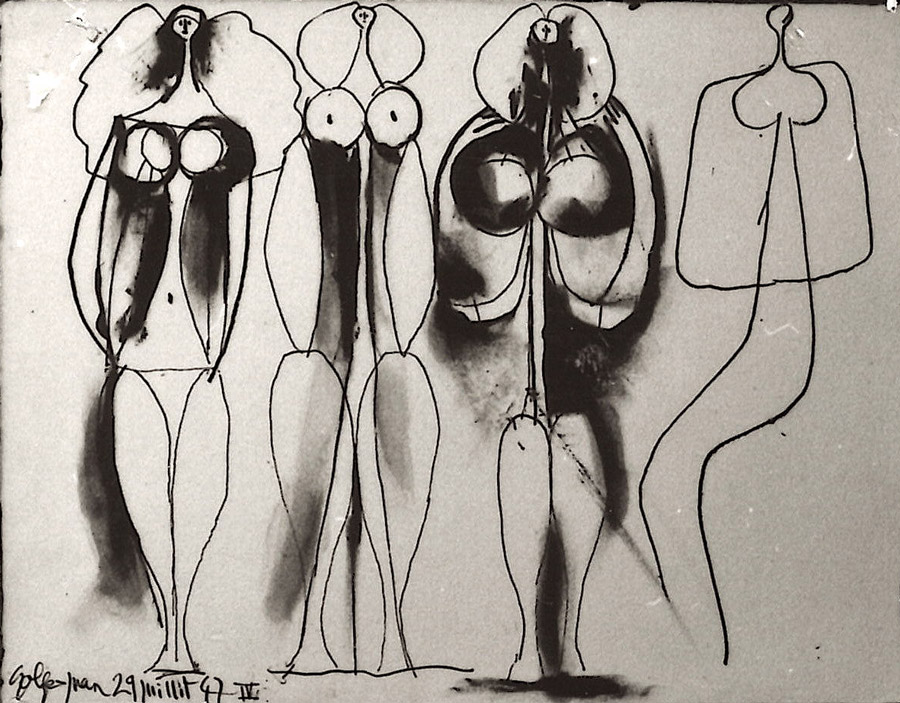
Chinese ink. Private collection.
© Succession Picasso 2020.
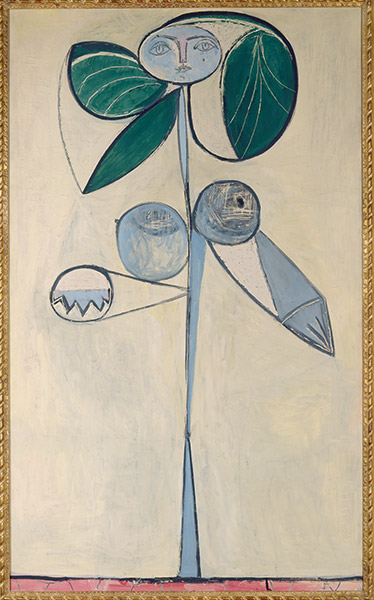
Oil on canvas. Private collection.
© Succession Picasso 2020.
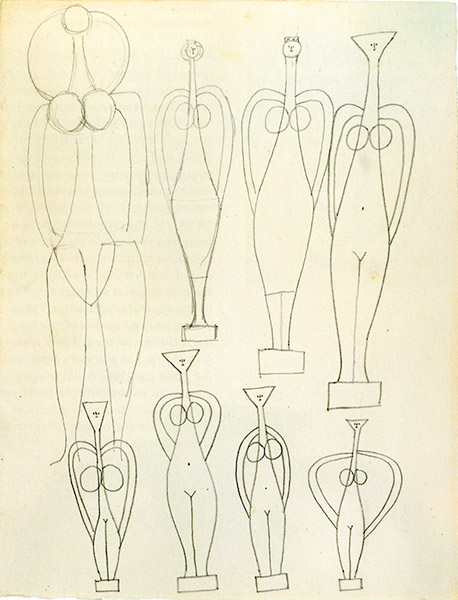
Pencil on paper.
Fundación Almine y Bernard Ruiz-Picasso para el Arte, Madrid
© FABA Photo: Eric Baudouin
© Succession Picasso 2020.
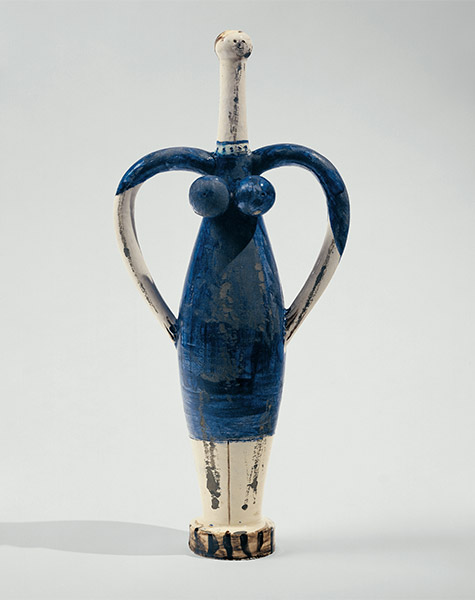
White terracotta incisions, slip and oxides under cover.
Fundación Almine y Bernard Ruiz-Picasso para el Arte, Madrid
© FABA Photo: Marc Domage
© Succession Picasso 20220.
7 / 10



 Summary